Creatine for Women Over 40: What the Evidence Actually Shows
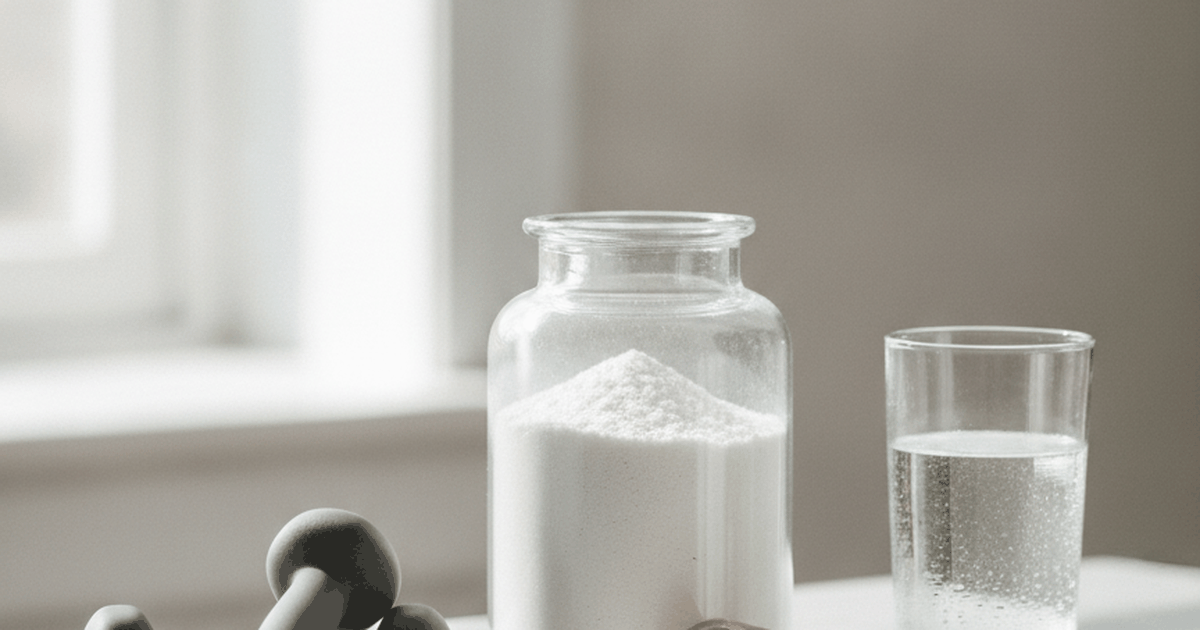
Creatine has spent thirty years being marketed at twenty year old men, photographed next to protein shakers and sold in tubs the size of paint pots. Which is a strange fate for a supplement whose modern research guest list looks nothing like that: postmenopausal women in 2 year bone trials, adults in their sixties and seventies in memory meta-analyses, women with depression in a psychiatric trial, older adults in 22 pooled resistance training studies. Researchers stopped treating creatine as a bodybuilding product years ago. The marketing simply has not caught up.
For a woman over 40, the backdrop makes the question genuinely worth asking. Adults lose roughly 3 to 8 per cent of their muscle per decade from their thirties onwards, and the years around menopause bring a measurably faster decline. Bone tells a sharper story still: women can lose in the region of 10 per cent of their bone density in the five or so years after menopause, and roughly one in two women over 50 will break a bone because of osteoporosis. Muscle, bone and energy all trend the same direction in the same decade, and all three respond to strength training supported by adequate nutrition, which is exactly the territory creatine operates in.
This article sets out what the evidence actually shows, graded honestly: what is strong, what is conditional, what is merely promising, which myths deserve to die, what to buy in the UK and how to take it. It is drawn from our book Creatine for Women Over 40: The Strength and Energy Playbook, and every claim below traces to named studies, not marketing copy.
This article is information, not medical advice. Speak to your GP before starting any supplement.
What Creatine Is, and What It Is Not
Creatine is a substance your body already makes and stores, mostly in muscle, where it powers the instant energy system your cells use for short, hard efforts: the first seconds of lifting a suitcase into an overhead rack, climbing stairs with a laundry basket, catching yourself when you trip on a kerb. Supplementing tops up those stores. That is the entire mechanism, and it is worth being equally clear about what creatine is not: it is not a steroid, not a hormone, not a stimulant, and it will not make you feel caffeinated or look bulky.
One detail matters specifically for women. Women tend to carry lower baseline creatine stores than men, partly because dietary creatine comes mainly from meat and fish and intakes differ. Starting further from full means supplementation often changes a woman's muscle creatine status more than it changes a man's, a point made in the review literature focused on female physiology led by researchers such as Abbie Smith-Ryan.
The Evidence, Graded by Outcome
Strong: strength and lean muscle, with training
The International Society of Sports Nutrition position stand on creatine, published in 2017 under lead author Richard Kreider, concluded that creatine monohydrate is the most effective legal supplement available for increasing high intensity exercise capacity and lean body mass during training, and that use in studies running up to five years has been safe and well tolerated in healthy people. Note the phrase "during training". In trials where participants supplemented without training, muscle outcomes were small to nonexistent. Creatine loads the spring; training releases it.
For midlife readers, the most relevant synthesis is a 2017 meta-analysis by Philip Chilibeck and colleagues, pooling 22 randomised trials with 721 participants, women and men with average ages between 57 and 70, all performing resistance training two to three days a week. Those on creatine gained on average 1.37 kg more lean tissue than those on placebo doing identical training, alongside greater upper and lower body strength. An extra kilogram and a bit of lean tissue is invisible on a beach; against a backdrop of 3 to 8 per cent muscle loss per decade, it is years of decline bought back, from a teaspoon of powder costing pennies.
Women specifically? A 2021 systematic review in Nutrients by dos Santos and colleagues, looking at creatine plus resistance training in older females, found greater strength gains compared with placebo plus the same training, though effects on measured muscle mass were less consistent, partly because the female trials were smaller and shorter. The Smith-Ryan review adds that post-menopausal women may see the clearest muscle size benefits in higher dose protocols, while standard 3 to 5 gram daily doses reliably support strength and performance when combined with training.
Conditional: bone
One sentence to hold onto: creatine is not a bone supplement, but it may be a useful assistant to the thing that is, which is loading your skeleton through resistance training.
The trials disagree in instructive ways. An early 12 month trial in postmenopausal women combining creatine with supervised lifting reported slower loss of bone density at the femoral neck, the region of the hip that matters most for fracture. The follow up was one of the largest creatine trials ever run: a 2 year randomised controlled trial published in 2023, in 237 postmenopausal women with a mean age of 59, taking roughly 10 grams daily or placebo alongside resistance training three days a week. The headline was negative: creatine made no difference to bone density scans. The secondary results were more interesting: improvements in some geometric properties of the hip that relate to bending strength, faster walking speed over 80 metres, and greater lean mass among those who stuck to the protocol. And a separate 2 year trial giving older women 3 grams daily with no structured training found no bone benefit at all. No training stimulus, no effect, exactly as the mechanism predicts.
The fair summary: do not take creatine expecting your DEXA scan to improve because of the powder. Take it, if you take it, because it helps you train harder, hold more muscle and walk faster, with any structural bonus on top. Training, protein, calcium and vitamin D carry the real weight of bone evidence.
Emerging: brain fog and mood
This is where the internet gets ahead of the data. The brain maintains its own creatine stores, but raising brain creatine appears slower and harder than raising muscle creatine. The best synthesis on memory, a 2023 meta-analysis in Nutrition Reviews led by Konstantinos Prokopidis, found creatine improved memory performance in healthy adults, with the clearest effect in older adults aged 66 to 76. A 2024 meta-analysis reported small benefits in memory and processing speed. Small is the operative word: statistical effects across pooled studies, not a fog lifting overnight, and no trial yet shows that 3 to 5 grams daily fixes perimenopausal cognitive complaints specifically.
On mood, one study gets quoted at women constantly, so here is its full shape. In 2012, In Kyoon Lyoo and colleagues randomised 52 women with diagnosed major depressive disorder, all on the antidepressant escitalopram, to add 5 grams of creatine daily or placebo. After 8 weeks, 52 per cent of the creatine group were in remission versus about 26 per cent on placebo. A real, well designed result, and a narrow one: creatine added to prescribed medication under psychiatric care, in clinical depression, not low mood in perimenopause, and not yet replicated at scale. Nothing here is a suggestion to self treat; persistent low mood deserves a GP conversation. And on hot flushes and night sweats, there is simply no good evidence that creatine helps, so this article makes no such claim.
The Myths, Taken Apart
Bloating. The fear that stops more women than any other, and it deserves nuance rather than flat denial. Creatine does increase the water content of muscle cells; that is partly the point, because a better hydrated muscle cell favours performance. But the water sits inside muscle cells, not under the skin and not around your middle: it is the opposite of the puffy premenstrual feeling. Visible scale jumps are largely a loading phenomenon at 20 grams a day. At 3 to 5 grams daily, stores rise gradually over three to four weeks and many women notice no scale change whatsoever; reported weight gain in female studies is smaller and less consistent than in male ones. Whatever small water gain occurs is not fat, and it reverses within weeks if you stop.
Hair loss. Follow this one to its source and you find a single study standing alone. In 2009, a small trial on around 20 college age male rugby players in South Africa measured DHT, a hormone involved in male pattern baldness, rising during a heavy loading week while staying within the normal clinical range. The study never measured hair, hair density or anything about follicles, included no women, lasted three weeks, and its hormone finding has not been replicated in the seventeen years since. No study anywhere has documented creatine causing hair loss in men or women. Midlife hair thinning is common around menopause, and the evidence points at hormonal shifts, iron status and thyroid function, all worth a GP conversation, none of them a teaspoon of creatine.
Kidneys. This myth survives on a coincidence of chemistry. Creatine breaks down into creatinine, which happens to be the standard blood marker doctors use to estimate kidney function, so supplementing can nudge the reading up without your kidneys struggling at all. Studies using markers unaffected by muscle and diet, such as cystatin C, show normal kidney function in creatine users whose creatinine based estimates looked worse. The direct evidence is reassuring: the 2017 ISSN position stand found creatine safe and well tolerated in studies up to five years, and a 2025 systematic review in BMC Nephrology pooling randomised trials found no significant harm to kidney function at standard doses in healthy adults. Two firm boundaries: all of that concerns healthy kidneys, so any kidney condition means doctor first, always; and if you have blood tests coming up, tell your surgery you take creatine so the reading is interpreted correctly.
Creatine for Women Over 40: The Strength and Energy Playbook
The full evidence review, UK buying guide and an 8 week strength plan. £3.99 Kindle or £6.99 PDF and EPUB.
Get the PlaybookBest Creatine for Women UK: What to Buy and What It Costs
The purchase is simpler than the supplement aisle makes it look. Buy plain creatine monohydrate powder. It is the form used in the overwhelming majority of the research, including effectively all the women's trials cited above, and the form the ISSN position stand names as the standard. Alternatives such as hydrochloride, ethyl ester and buffered creatine have never demonstrated superiority in head to head trials; they exist to justify higher prices, not better outcomes. The same goes for pink tubs and "creatine for her" blends: every major female study used ordinary monohydrate, and there is no published evidence any boutique formula outperforms it in women.
UK prices, as 2026 bands to sense check at purchase:
- Standard monohydrate: a one kilogram pouch from mainstream UK sports nutrition retailers typically sells for £20 to £30 at full price, and these retailers discount constantly. One kilogram at 5 grams a day lasts 200 days, roughly 10 to 15 pence a day.
- Creapure versions: Creapure is branded German made monohydrate from AlzChem, manufactured to tight purity specifications, typically £40 to £55 per kilogram. A reasonable preference, not a scientific necessity.
- Informed Sport: a UK certification run by the laboratory group LGC under which every batch is tested for banned and undeclared substances. Several UK retailers sell certified creatine at ordinary prices; a worthwhile signal, and essential if you compete in a tested sport.
One format warning. Creatine gummies now have a genuine scandal attached: through 2024 and 2025, independent laboratory testing repeatedly caught gummies failing label claims. One manufacturer's testing of competitor products in 2024 found 5 of 12 failed, including three containing essentially no creatine at all, and 2025 follow up testing found popular gummies, some with glowing marketplace reviews, delivering a small fraction of the labelled dose. Part of the problem is baked into the format, because creatine degrades in warm, wet manufacturing conditions. Skip gummies. If plain powder in water bothers you, stir it into juice, squash or yoghurt, where 3 to 5 grams is undetectable. And the one label check that matters: the ingredients list should say creatine monohydrate and almost nothing else.
The Dose and the Routine: 3 to 5 Grams, Every Day
Take 3 to 5 grams of creatine monohydrate once a day, every day, training days and rest days alike. That is the whole protocol. A flat teaspoon is roughly 3 grams and a slightly heaped one roughly 5; larger and more muscular women sit sensibly at the top of the band, smaller women at the bottom, and precision beyond that is not worth chasing.
Skip loading. The old 20 grams a day protocol saturates muscles faster, but it buys only speed: a steady 3 to 5 grams reaches the same full tank in three to four weeks, with less gastric grumbling and none of the sharp early water gain that panics people on the scale. Timing barely matters, because creatine works by keeping stores topped up, not as a pre workout hit, so anchor it to a habit you never skip: morning tea, breakfast, the glass of water after brushing your teeth. Coffee does not cancel it. A missed day is a rounding error, since stores drain over weeks, not hours, and there is no cycling requirement.
Set your expectations by the honest timeline. Weeks one and two: nothing you can feel, which is normal and is exactly when the impatient quit. Weeks three and four: the last repetition of a set feels slightly more possible and you recover a little faster between sets. From month three, with training, the measurable lean tissue differences the meta-analyses report are built. And remember the operative condition throughout: without two or three strength sessions a week, the tub on the counter is not the intervention.
Who Should Not Start Without Speaking to a GP
Most healthy women over 40 can take creatine at these doses with an excellent safety record behind them. The following groups should have a medical conversation first, and this list is deliberately conservative:
- Anyone with kidney disease, reduced kidney function, a single kidney or a history of kidney problems. The safety evidence is built on healthy kidneys.
- Anyone pregnant, trying to conceive or breastfeeding: supplement decisions in this window belong with your midwife or GP.
- Anyone on regular medication, particularly medicines that affect the kidneys such as certain blood pressure drugs, regular high dose anti-inflammatories or diuretics, and anyone with diabetes, where kidney monitoring is routine.
- Anyone with bipolar disorder or under psychiatric care, who should treat the mood research above as a reason for a professional conversation, never self experimentation.
- Everyone, in one small administrative way: tell your surgery you take creatine before any blood test, so the creatinine reading is interpreted correctly.
Frequently Asked Questions
Is creatine good for women over 40?
The strongest evidence is for strength and lean muscle when creatine is combined with resistance training. A 2017 meta-analysis pooling 22 randomised trials in 721 older adults found those taking creatine gained on average 1.37 kg more lean tissue than those on placebo doing identical training, alongside greater upper and lower body strength. Without training, muscle outcomes are small to nonexistent, so the supplement supports a strength programme rather than replacing one.
Does creatine cause bloating or weight gain in women?
Creatine draws water into muscle cells, not under the skin or around the middle, so it is not the puffy fluid retention feeling. Noticeable water gain is largely a loading phenomenon at 20 grams a day; at the recommended 3 to 5 grams daily, stores rise gradually over three to four weeks and many women notice no scale change at all. Reviews of female studies report smaller and less consistent weight change than in male ones, and any water gain reverses within weeks of stopping.
Does creatine cause hair loss?
No study anywhere has documented creatine causing hair loss in men or women. The scare traces to a single 2009 three week study of around 20 young male rugby players, which measured a rise in the hormone DHT but never measured hair at all, included no women, and has not been replicated since. Later safety reviews measuring hormones in creatine users have not confirmed a meaningful androgenic effect.
What is the best creatine for women in the UK?
Plain creatine monohydrate powder. It is the form used in effectively all the women's trials and the form the International Society of Sports Nutrition names as the standard. Expect £20 to £30 per kilogram from mainstream UK sports nutrition retailers, roughly 10 to 15 pence a day at 5 grams, with Creapure branded German made versions at £40 to £55 per kilogram. Informed Sport certification signals every batch is independently tested. Avoid gummies: laboratory testing in 2024 and 2025 caught many badly under dosed, some containing almost no creatine.
How much creatine should a woman over 40 take daily?
3 to 5 grams of creatine monohydrate once a day, every day, training days and rest days alike. Loading is unnecessary: a steady daily dose reaches the same full muscle stores in three to four weeks with less stomach upset and no sharp early water gain. Timing barely matters, mixing it into tea, juice or yoghurt is fine, coffee does not cancel it, and a missed day is a rounding error.
The Honest Bottom Line
Creatine monohydrate at 3 to 5 grams daily is cheap, spectacularly well studied and safe for healthy adults, with strong evidence for strength and lean muscle when paired with training, a conditional and modest story for bone, and an emerging but unproven story for the midlife brain. Buy it for the muscle evidence and treat anything else as a bonus you were not paying for. And keep the priorities in order: the powder supports the training, the protein, the sleep and the medical care; it never replaces them. Starting at 44 is better than 54, and starting at 64 is better than never, by a wide margin.
Creatine for Women Over 40: The Strength and Energy Playbook
The full evidence review, UK buying guide and an 8 week strength plan. £3.99 Kindle or £6.99 PDF and EPUB.
Get the PlaybookRelated Reading
- The Cortisol Reset, a grounded look at stress hormones in midlife and what actually moves them.
- Sleepmaxxing, the evidence sorted from the trend for genuinely better nights.
- Fibermaxxing, why fibre is the most underrated lever in the UK diet and how to raise it without misery.